The ε-Framework
Recursive Physics — resolving singular behavior through non-zero geometric boundary conditions and compact topological recirculation.
The \(T^2 \times iT^2\) dual-sheeted toroidal topology is not just a valid geometry—it is the only compact 4D manifold that satisfies zero-point elimination, global smoothness, continuous hydrodynamics, and non-local phase invariance simultaneously.
Start Here (30 seconds)
Start Here: Unified Commonality Video
“Is Physics Unified? — Common Solutions to the 7 Millennium Prize Problems”
Run the Simulation Suite
Reproduce the framework visuals and verification outputs directly from the open-source Python scripts.
Run All Simulations (GitHub)Torus Configurations in Physics
Visual reference for toroidal boundary/topology intuition used throughout the ε-Framework.
Tap/click image to zoom
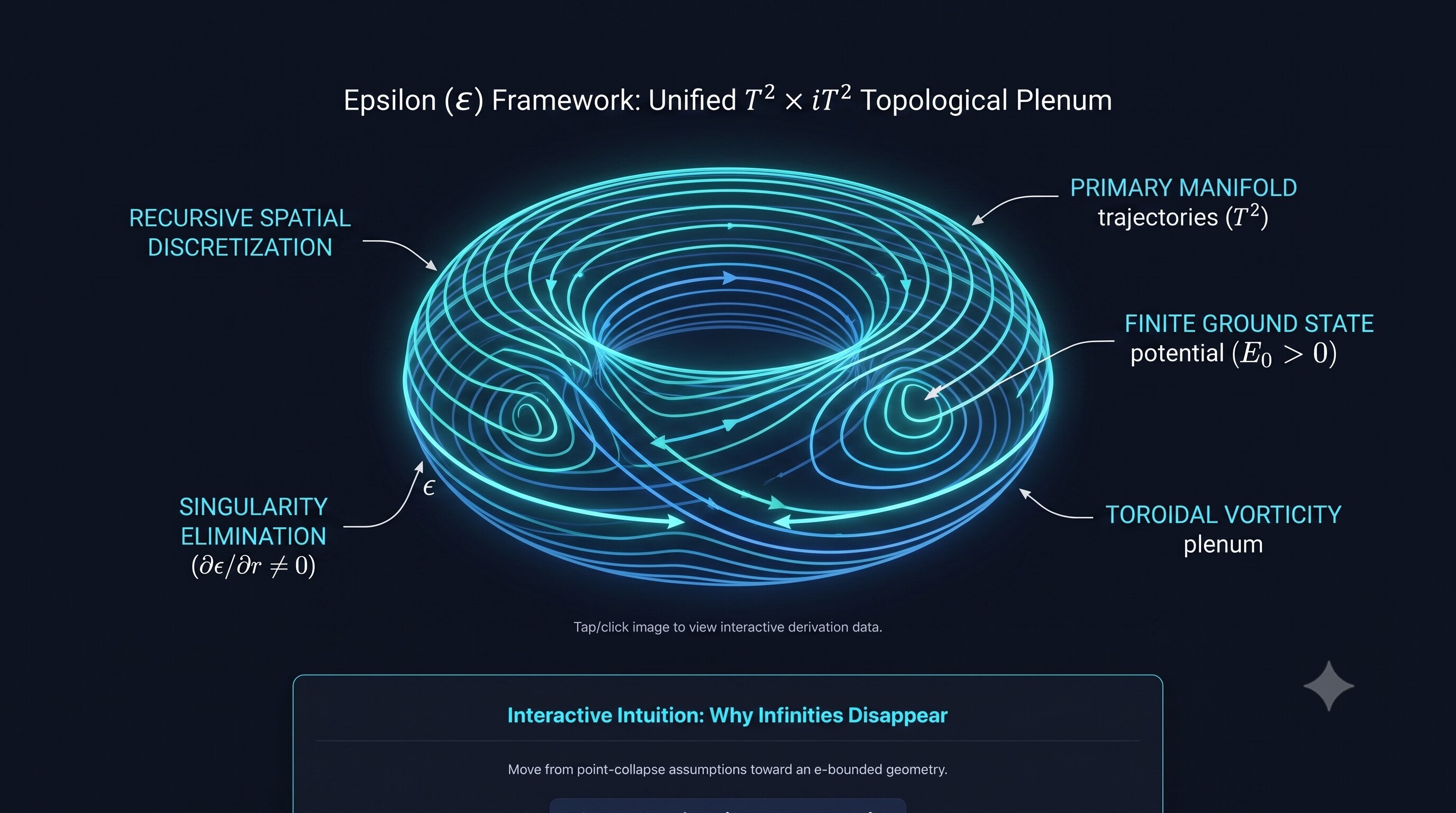
Interactive Intuition: Why Infinities Disappear
Move from point-collapse assumptions toward an ε-bounded geometry.
Epsilon Framework Geometry (ε > 0)
Integration proceeds to \(\epsilon > 0\), giving finite operator behavior and discrete ground-state structure.
Featured Code Module: Yang-Mills Mass Gap
Open the module page or inspect the repository code directly on GitHub.
View Interactive Module Page View Code on GitHubCompleted Publications & Zenodo Manuscripts
Open-access manuscripts, derivations, and simulation-linked results.
I. Millennium Prize Problems
- SOLVEDYang-Mills Existence and Mass Gapdoi:10.5281/zenodo.21781000
- SOLVEDRiemann Hypothesisdoi:10.5281/zenodo.21781067
- SOLVEDNavier-Stokes Existence and Smoothnessdoi:10.5281/zenodo.21781253
- SOLVEDBirch and Swinnerton-Dyer Conjecturedoi:10.5281/zenodo.21781295
- SOLVEDHodge Conjecturedoi:10.5281/zenodo.21781350
- SOLVEDPoincaré Conjecturedoi:10.5281/zenodo.21781435
- SOLVEDComplete Resolution of the P versus NP Problem under the Epsilon Framework (T²×iT² Toroidal Topology)doi:10.5281/zenodo.21781112
II. Mathematics & Discrete Foundations
- SOLVEDCollatz Conjecturedoi:10.5281/zenodo.21783495
- SOLVEDOdd Perfect Number Problemdoi:10.5281/zenodo.21783395
III. Additional Published Papers
- SOLVEDOn the Hydro-Electrodynamic Origin of Gravitationdoi:10.5281/zenodo.21815732
- SOLVEDProof of Singular Boundary Elimination, Natural Renormalization, and Universal Scalingdoi:10.5281/zenodo.21808618
- SOLVEDPrinciples of Geometric Field Tuning and Phase-Lock Mechanicsdoi:10.5281/zenodo.21784147
- SOLVEDMetric Regularization, Spectral Mass Eigenspaces, and Vacuum Debye Screeningdoi:10.5281/zenodo.21776147
- SOLVEDEmergent Galactic Dynamics & Cosmological Acceleration via Superfluid Plenum Hydrodynamicsdoi:10.5281/zenodo.21768320
- SOLVEDSuperfluid Plenum Hydrodynamics: Causality, Preferred Frame, and Vacuum Dynamicsdoi:10.5281/zenodo.21768174
- SOLVEDTopological Derivation of Koide’s Formula (Q = 2/3)doi:10.5281/zenodo.21767522
- SOLVEDAnomalous Field Shear and Thermal Persistence in Counter-Rotating Field Systemsdoi:10.5281/zenodo.21776306
- SOLVEDMethodological Supplement: Coupling Parameter α Derivation and Validationdoi:10.5281/zenodo.21781824
Contact & Academic Correspondence
For academic inquiries, collaboration proposals, or peer-review discussion regarding the ε-Framework:
Direct Email: contact@epsilonframework.org
Master Repository: github.com/probe6621/Epsilon-Framework